
Case Study
Bio-Inspired Clamping, Twist-Lock & Adaptive Stabilization System for Special Needs Mealtime
Client: JNG Solutions
- Mechanical
Introduction
In pediatric occupational therapy and special education, developmental milestones often hinge on functional daily routines. For children with Level 3 Autism, eating independently is a complex challenge influenced by dyspraxia, fine motor deficits, and high sensory sensitivity. Standard consumer dining products consistently fail this demographic because suction bowls are easily dislodged, resulting in routine disruption, frustration, and food throwing.
JNG Solutions partnered with Landi Industries to tackle this challenge by developing a universal, child-proof mealtime stabilization unit. Leveraging our Modified Agile for Hardware Development (MAHD) framework, Landi Industries guided JNG Solutions through an upstream Design of Experiments (DOE), hand-drawn concept sketching, full 3D CAD modeling, bio-inspired materials engineering, rapid silicone mold prototyping, and full-scale manufacturing integration.
The Challenge
Conventional assistive dining items rely on standard suction cups or weighted bases. Children with severe autism quickly learn to compromise these designs by lifting the flexible silicone release tab, sliding the base across porous surfaces, or applying angled leverage. Once the dish is freed, the mealtime transforms from a learning interaction into a disruptive behavioral loop.
To break this pattern, JNG Solutions needed a device that could:
- Lock Securely across Multiple Surfaces: Anchor onto smooth surfaces (granite, Formica) and textured, porous surfaces (grainy hardwood, sealed wood).
- Eliminate All Separation Leverage: Combine a high-adhesion base pad with a completely novel twist-lock mechanism that anchors the dish to the base, preventing children from unscrewing, prying, or separating the dish from the table.
- Resist Intentional Pulling and Prying: Eliminate edge lift points to prevent removal regardless of pulling force or angle.
- Comply with Food Safety & Household Standards: Utilize non-toxic, biocompatible materials rated for food contact and withstand high-temperature residential dishwasher cycles.
- Scale Cost-Effectively: Transition smoothly from rapid 3D-printed prototypes and cast silicone to high-volume injection molding.
The Approach & Process
1. Upstream Validation & Requirements (Pre-CAD)
Before initiating physical hardware design, Landi Industries conducted a structured Design of Experiments (DOE) with families and occupational therapists (OTs). This research confirmed that children with Level 3 Autism struggle with bilateral coordination—using one hand to stabilize a plate while manipulating a utensil with the other.
Rather than trying to teach plate stabilization first, the engineering team set out to eliminate dish movement entirely. Removing the possibility of dish-throwing allowed the child’s motor focus to shift directly to dominant-hand utensil control (scooping and stabbing).
2. Competitor Failure Analysis
Landi Industries benchmarked standard marketplace products against high-impact force profiles:
- Suction Base Failures: Single-seal air vacuums fail when air enters micro-scratches on wooden surfaces, or when children lift the outer lip.
- Shear-Force Slippage: Standard rubber bases lack sufficient friction on smooth surfaces under horizontal pushing forces.
- Dish-to-Base Separation: Existing two-piece systems utilize basic friction fits or snap tabs that children easily defeat through twist-and-pull force.
Physical Manifestation & Multi-System Engineering
Landi Industries moved from hand-drawn industrial design concept sketches directly into high-fidelity SolidWorks parametric models. The core physical achievement required pairing advanced biomimetic materials science with a custom mechanical locking interface.
Dual-system stabilization mechanics
System 1: Base-to-table
Bio-Inspired Dual Surface Pad
- Shear friction on wood
- Micro-vacuums on granite
Prevents Base Motion
System 2: Dish-to-base
Novel Child-Proof Twist-Lock
- Internal mechanical detent
- Zero edge-leverage clearance
Prevents Dish Removal
1. First-of-its-Kind Clamping & Pad Combination
To achieve multi-surface adhesion without relying on prone suction mechanisms, Landi Industries engineered a custom base pad drawing inspiration from gecko foot adhesion (van der Waals forces and micro-contact area mechanics):
- Micro-Wedge Surface Adhesion: On smooth non-porous counter surfaces (e.g., polished granite or laminate), the micro-conforming silicone pad maximizes surface contact area, forming micro-vacuums that drastically increase vertical pull resistance without requiring an edge-lift tab.
- High-Friction Shear Resistance: On textured wood surfaces, the high-durometer, compliant silicone grips micro-grooves to eliminate horizontal sliding under shear force.
2. Novel Child-Proof Twist-Lock Solution
To ensure the dish itself could not be detached from the anchored base pad, Landi Industries developed a unique mechanical twist-lock interface:
- Flush Interlocking Geometry: Designed in SolidWorks PLM, the locking channels eliminate any gap or overhang between the dish and the base, depriving the child of fingers-under-lip leverage points.
- Directional Detent Lock: Features a positive tactile engagement mechanism that requires multi-directional force (press-and-rotate) to release—a movement pattern outside the typical pull-and-pry behaviors of young children.
Material Selection & Compliance Standards
Landi Industries specified 100% Platinum-Cured Food-Grade Silicone for the contact pad and dish interface:
- Biocompatibility & Safety: Platinum-cured silicone contains no filler oils, phthalates, or BPA, satisfying FDA 21 CFR 177.2600 regulations for repeated food contact surfaces.
- Thermal & Environmental Stability: Retains elastic memory and adhesion capabilities across temperatures from -40°C to 230°C, ensuring full residential dishwasher safety and sanitization resilience.
Rapid Prototype Iteration via 3D CAD & Printed Tooling
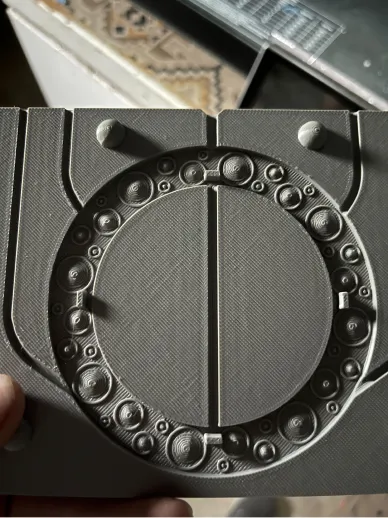
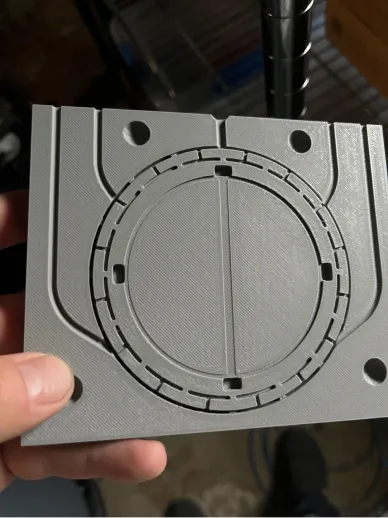
To bypass long lead-time steel tooling during testing, Landi Industries rapidly iterated low-fidelity 3D prints to evaluate the twist-lock ergonomics before casting silicone. The team 3D-printed food-safe, high-temperature resin molds to cast and test multiple silicone shore hardness levels (Durometer 30A to 60A) in-house.
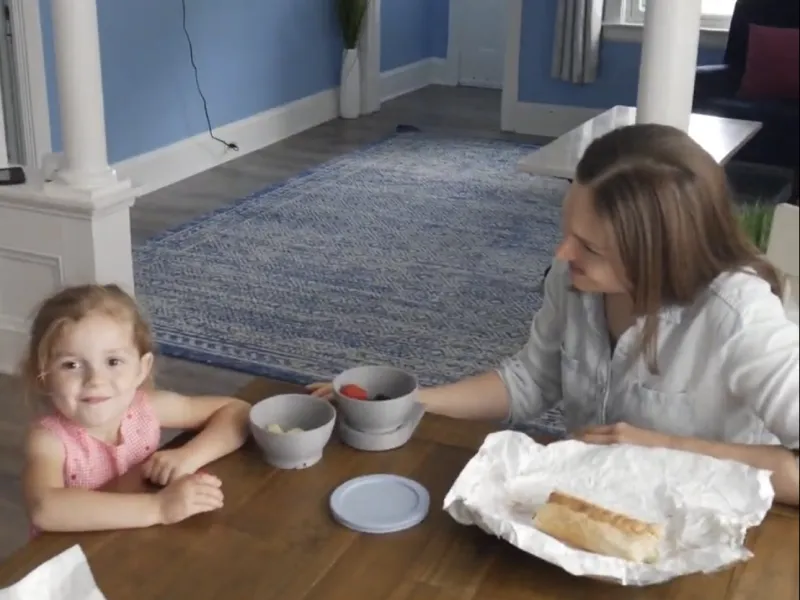
Functional prototypes were immediately distributed to pilot families and special education classrooms for real-world stress testing.
Finished model examples
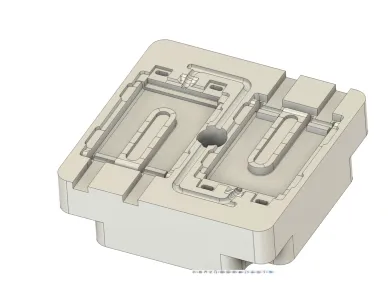
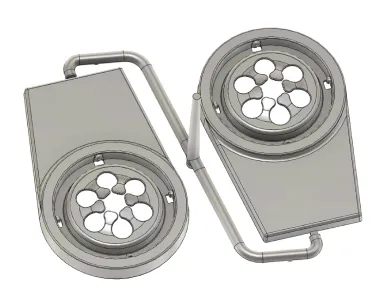
Digital Manifestation & Production Transition
Following successful pilot validation in homes and special education settings, Landi Industries shifted focus toward commercial scaling and market enablement:
- Tooling Integration: Guided JNG Solutions through technical handoff and injection mold tooling preparation with Converge Technologies.
- SolidWorks PLM Integration: Maintained full parametric design models, mechanical assembly drawings, and Bill of Materials (BOM) within SolidWorks PLM to ensure seamless design transfers and quality control.
- Go-To-Market & Marketing Support: Structured demonstration assets, technical datasheets, and clinical case summaries highlighting OT endorsement data to support early sales outreach.
The Result
The collaborative partnership delivered a market-ready assistive dining device that transforms mealtime dynamics for neurodivergent children and their families.
Transformation summary
Clinical Impact
Reported family, educator & therapist feedback
- Disrupted dish-throwing loops
- Accelerated spoon/fork adoption
- Decreased OT/parent interventions
Operational Impact
- 100% Dishwasher Safe
- Universal table mounting
- Production-ready tooling
Feedback from families and educators confirmed the product’s impact, with therapists characterizing the device as a “game changer” for self-feeding development. Landi Industries helped JNG Solutions take a mechanical hypothesis and turn it into a validated, scalable, and life-changing commercial asset.
Services Rendered
Research and Development
- User interviews (i.e., comprehensive user & caregiver personas)
- Process mapping (i.e., end-to-end mealtime behavioral journeys)
- User-driven product requirements
- Competitor product failure analysis
Design and Creation
- Hand-drawn industrial design concepts & rapid design iteration sketches
- Photoshop visual renderings (i.e., early customer feedback loops)
- SolidWorks with PLM (i.e., complete 3D CAD modeling, mechanism design, and complete assembly creation)
- First-of-its-kind dual-action surface pad & universal clamping mechanism design
- Novel child-proof twist-lock dish attachment engineering
Prototyping & Testing
- Rapid 3D-printed tooling and silicone molding
- Multi-surface shear, vertical pull, and stress failure testing
- Food-grade materials compliance assessment
- Field testing in special education classrooms and pilot homes
Project Management & Manufacturing Enablement
- Modified Agile Hardware Design (MAHD)
- JIRA CMMI for internal work tracking & Harvest integration for project oversight
- Tooling transition (Converge Technologies) & go-to-market marketing collateral