
Case Study
Drop-In Modular CEA Shipping Container & Dual-Revenue Urban Agriculture Platform
Client: Urban Farming Initiative
- Mechanical
- Electrical
- Firmware
- PLC
Introduction
Urban agriculture and Controlled Environment Agriculture (CEA) hold real promise for hyper-local food production, food desert remediation, and resilient municipal food supply chains. Commercial vertical farming, though, has a track record of heavy capital expenditure (CapEx), unpredictable crop margins, and rigid infrastructure that resists modular maintenance.
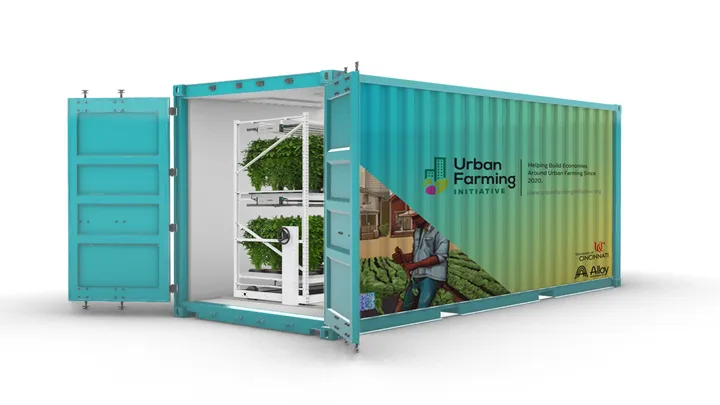
Urban Farming Initiative partnered with Landi Industries to engineer a turn-key, drop-in hydroponic farm retrofitted into a standard intermodal shipping container. Working in our Modified Agile for Hardware Development (MAHD) framework and drawing on Landi Industries’ hands-on agricultural background, which spans commercial high-density specialty brassica cultivation (harvesting 90 heads weekly) and controlled laboratory botanical research, we guided the client through a 3-to-4 month market discovery phase, competitive benchmarking, a complete physical container build-out, mission-critical remote telemetry integration, and a dual-revenue business model built on urban street-level advertising.
The Challenge
Traditional containerized vertical farms face structural, economic, and operational bottlenecks that limit broad community adoption:
The Commodity Crop Trap:
Most vertical farms try to compete head-on with open-field commodity crops like standard lettuce or tomatoes. That setup consumes immense spatial volume, demands heavy artificial light energy, and returns little nutritional density or commercial margin to the host community.
Thermal Load & HVAC Vulnerability:
Retrofitted steel shipping containers conduct heat readily and sit exposed to outdoor extremes. Holding the internal vapor pressure deficit (VPD), humidity, and temperature profile steady requires high-performance insulation and closed-loop environmental control. A single HVAC or heating compressor failure can wipe out an entire crop cycle within hours.
Rigid Build-Outs & Maintenance Inflexibility:
Conventional drop-in grow labs bury plumbing lines, wiring, and ductwork permanently behind walls, making field maintenance, sanitization, or technology upgrades over a multi-year lifecycle cost-prohibitive.
Harsh-Environment Remote Management:
Urban installations need continuous, low-latency monitoring across geographically dispersed sites. Operators need defense-grade, failsafe remote telemetry to monitor atmospheric health, manage environmental recipes, and diagnose mechanical faults without full-time on-site labor.
The Approach & Process

Discovery, User Personas & General Scoping (Months 1–2)
Landi Industries opened the engagement with a 3-to-4 month research study to define the operational, mechanical, and commercial bounds of modern drop-in CEA systems:
Market & Customer Profiling: Mapped user personas spanning community non-profits, urban educational facilities, commercial restaurateurs, and micro-farm entrepreneurs to capture their differing technical capabilities and yield expectations.
Secondary Market Matrix Analysis: Evaluated new, used, and decommissioned container platforms across the nation, analyzing pricing thresholds, asset depreciation curves, failure modes (thermal bridging, corrosion, root rot), and feature offerings to pinpoint market gaps.

Agronomic Specialization: High-Value, Out-of-Season Cultivation
Rather than configuring the container for low-margin, high-volume commodity crops such as head lettuce or sprawling fruiting plants, Landi Industries directed the agronomic engineering toward high-value, out-of-season specialty crops.
Drawing on direct operational background in commercial specialty brassicas and laboratory experimental strains, the team calibrated the facility for compact, high-value botanicals:
Maximized Nutritional Return: Focused the facility on high-potency, micronutrient-dense varieties that give urban communities real nutritional value rather than low-calorie water weight.
Insulation from Commodity Price Collapses: Stepped out of the race-to-the-bottom margins of bulk field produce by targeting fragile, high-spoilage herbs and out-of-season crops that command strong local price premiums.
Optimized Photonic Efficiency: Prioritized crops with compact vegetative canopies, avoiding the heavy labor, manual pollination, and wasted volume that larger row or vining crops bring to a closed container envelope.

Dual-Revenue Architectural Innovation (Crops + Out-of-Home Media)
To de-risk the venture’s financial model, Landi Industries recognized that urban placement brings high-value street and pedestrian visibility. The team analyzed commercial Out-of-Home (OOH) media economics, evaluating Cost Per Day (CPD), Cost Per Mille (CPM, or cost per thousand impressions), municipal billboard zoning ordinances, and street furniture advertising rates:
Dual-revenue asset monetization
Exterior asset value
Street-Level Out-of-Home Media
- Billboard & display integration
- High-density urban CPD monetization
- Offsets initial capital amortization
Predictable Cash Flow
Interior asset value
High-Density Modular Hydroponics
- Continuous specialty crop yield
- Controlled environment stability
- Hyper-local produce distribution
Agricultural Revenue
Physical Manifestation & Mission-Critical Systems Architecture
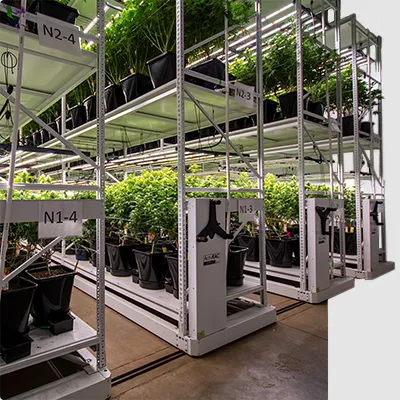
Landi Industries moved from conceptual industrial renderings into full architectural engineering and direct physical construction, converting a raw intermodal shipping container into an enterprise-grade drop-in cultivation facility.
Modular drop-in container architecture
Structural & thermal envelope
- Continuous thermal barrier insulation eliminating all steel bridging
- Sealed, anti-microbial cleanroom wall surfaces
Mission-critical climate control (HVAC & heating)
- Dual-redundant heating and cooling stages
- Automated failover logic preventing thermal shock and crop loss
Hard-access remote telemetry & controls
- Hardened edge gateway with cellular/Ethernet failover
- Defense-grade remote monitoring of pH, EC, DO, VPD, and power rails
Serviceable utility & hydroponic suite
- Quick-disconnect modular grow racks and plumbing manifolds
- Accessible electrical and drainage raceways for zero-downtime maintenance
Thermal Envelope & Redundant Environmental Controls
Elimination of Thermal Bridging: Retrofitted internal stud framing with closed-cell continuous thermal barrier insulation to isolate the internal atmosphere from ambient weather and keep HVAC efficiency high.
Redundant HVAC & Heating Architectures: Built out primary and secondary environmental stages with automated failover logic. If a primary heating or cooling loop fails, the backup stage engages immediately to preserve crop integrity and prevent catastrophic thermal swings.
Defense-Grade Remote Access & Hardened Telemetry
Drawing on Landi Industries’ background in defense-grade and hard-access industrial systems, the team designed a robust remote telemetry architecture:
Remote Monitoring & Command Gateway: Integrated an industrial-grade edge gateway with dual-path communication (cellular IoT with local Ethernet failover), so operators can securely manage photoperiod timing, environmental setpoints, and pump staging from anywhere.
Automated Fault Diagnostics: Continuous real-time sensor loops monitor ambient temperature, relative humidity, vapor pressure deficit (VPD), water temperature, pH, electrical conductivity (EC), and electrical power consumption, pushing instant alerts to operators when telemetry drifts out of range.
Standardized Electrical & Quick-Swap Serviceability
Integrated Distribution Panel: Executed clean, code-compliant conduit rough-ins and load-balanced electrical distribution to support sustained lighting arrays, ventilation fans, and industrial pumps.
Modular Service Architecture: Grow racks, nutrient manifolds, and sensor suites were engineered with quick-disconnect fittings on accessible tracks, so individual components or whole systems can be swapped out for sanitization or maintenance without taking the container offline.
The Result
Landi Industries provided Urban Farming Initiative with a validated, fully engineered physical product and a robust commercial roadmap:
Production-Ready Functional Facility: Delivered an end-to-end engineered, drop-in capable agricultural container with complete mechanical, electrical, plumbing (MEP), and redundant HVAC infrastructure, ready for immediate urban deployment.
De-Risked Payback Profile: Pioneered the dual-revenue model that pairs street-level advertising revenue with high-yield indoor food production, giving operators cash-flow diversification from day one.
Field-Hardened Reliability: Defense-grade remote monitoring and redundant heating and cooling provide total operational visibility and failsafe protection against crop-destroying hardware failures.
Lifecycle-Optimized Hardware: The quick-swap modular design eliminates long maintenance shutdowns, enabling continuous, cleanroom-grade growing operations across multi-year cycles.
Services Rendered
Research and Development
- 3-to-4 month market discovery, user personas & operator journey mapping
- Agronomic system design (based on commercial brassica operations & laboratory experimental growth chambers)
- Competitive benchmarking, used-market analysis & feature-matrix evaluations
- Urban OOH advertising feasibility, pricing models (CPD/CPM), and municipal zoning research
Design and Creation
- Architectural space planning & internal cleanroom structural layouts
- SolidWorks 3D modeling for hydroponic rack systems & plumbing manifold routes
- Exterior industrial design concepts & advertising visualization renderings
- Electrical system schematics, service load calculations, and breaker distribution design
- Dual-redundant HVAC and heating mechanical design & thermal insulation calculations
- Defense-grade remote telemetry & secure network access architecture
Physical Fabrication & Hands-On Build
- Shipping container retrofitting, structural wall studding & continuous insulation installation
- Complete rough-in and termination of internal electrical, lighting, and HVAC conduits
- Plumbing manifold construction, drainage integration, and pump/reservoir staging
- Modular quick-swap track and utility hookup integration
Project Management & Commercial Enablement
- Modified Agile Hardware Design (MAHD) iterative project management
- Drop-in installation procedures & facility site-prep documentation
- Dual-revenue commercialization framework & advertising sponsorship pitch assets