
Case Study
MarshDefense: Modular Bio-Grid Floating Breakwaters & Nature-Based Coastal Resilience
Client: MarshDefense
- Mechanical
Introduction
Across the Great Lakes, coastal urban centers, and inland waterways, rising water levels, extreme storm surges, and shoreline erosion threaten billions of dollars in public waterfront assets and port infrastructure. In high-density freshwater environments like Chicago’s Lake Michigan shoreline, protection has long meant rigid gray infrastructure: massive concrete seawalls, stone rip-rap, and steel sheet piling. These structures carry exorbitant capital costs, reflect destructive wave energy back into the littoral zone, and accelerate the loss of critical coastal habitats. Conventional polymer floating barriers, meanwhile, rely on petroleum-based plastics such as high-density polyethylene (HDPE) shells and expanded polystyrene (EPS) cores, which degrade under UV exposure and ice shear and shed non-biodegradable microplastics directly into municipal drinking water supplies.
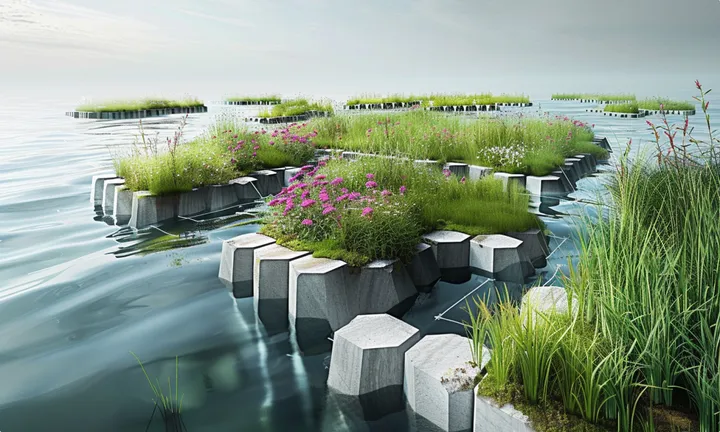
Landi Industries partnered with MarshDefense to engineer the “Bio-Grid” ecosystem: a nature-based, 100% bio-based modular floating breakwater platform designed to dissipate up to 70% of hydrodynamic wave energy while eliminating synthetic microplastic liability. Recognized by World Business Chicago’s Horizon Lines: Visions for Chicago 2050 design initiative, MarshDefense replaces crumbling concrete bulkheads with living, hexagonal marsh islands that absorb dynamic wave forces, remediate urban runoff, and restore native aquatic nursery habitats.
The Challenge
Urban freshwater shorelines present a compounding set of physical, environmental, and financial constraints:
Hydraulic Reflection & Seabed Undermining
Vertical concrete bulkheads act as reflective barriers. Rather than dissipating storm energy, they redirect wave force downward, scouring the lakebed, stripping benthic ecosystems, and causing coastal collapse.
Microplastic Contamination from Plastic Foams
Conventional floating wave attenuators rely on synthetic polymers. In freezing freshwater climates, winter ice grinding and UV degradation fracture these casings, releasing non-biodegradable microplastics and EPS beads into local water systems.
Severe Great Lakes Freeze-Thaw & Ice Crushing
Winter freeze cycles across northern waterways generate expanding ice sheets that crush standard hollow plastic floats and rip rigid fixed pilings out of the lakebed.
Nonpoint Source Runoff & Toxic Algal Blooms
Urban runoff laden with excess nitrogen and phosphorus flows into lakefront basins and industrial slips, sparking seasonal Harmful Algal Blooms (HABs) that degrade water quality and trigger beach closures.
High Capital Expenditure
Hard engineering seawalls cost between $1,500 and $4,000 per linear foot to build, and need barge cranes and a complex permitting process.
The Approach & Process
Operating within Landi Industries’ Modified Agile for Hardware Development (MAHD) framework, the project began with an extensive feasibility, materials sourcing, and hydrodynamics study to bridge advanced non-petroleum composite engineering with urban coastal defense:
System transformation matrix
Before
Conventional seawalls
- $1,500 – $4,000 / linear ft
- Reflective wave scour
- Benthic habitat destruction
- Microplastic contamination risk
After
MarshDefense Bio-Grid architecture
- $250 – $600 / linear ft installed
- Dissipative wave attenuation (up to 70%)
- Living Floating Treatment Wetlands (FTWs)
- 100% non-toxic bio-based biodegradation
Biomimetic Material Science & Institutional R&D
Landi Industries orchestrated an applied research network across leading national laboratories and universities to establish a fully domestic, non-petroleum structural composite supply chain:
Bio-Thermoset Outer Shell (AESO & NFRP): Formulated an Acrylated Epoxidized Soybean Oil (AESO) bio-resin cross-linked with plant-derived anhydrides, partnering with Washington State University’s Composite Materials and Engineering Center (CMEC). The resin is infused into continuous woven industrial hemp and flax fiber preforms, yielding a structural composite with high flexural toughness and permanent freshwater resistance.
Nanoscale Reinforcement (UMaine PDC): Interleaved cellulose nanofibril (CNF) and microfibrillated cellulose (MFC) webs, developed with the University of Maine Process Development Center, between natural fiber plies to resist cyclic interlaminar shear fatigue from multi-directional storm swells.
Hydrophobic Lignin Surface Chemistry: Integrated organosolv lignin and silane coupling treatments (evaluated with Michigan State University and the USDA Forest Products Laboratory) directly onto natural plant fibers prior to infusion. This surface modification prevents water ingress, fiber swelling, and hydrolytic degradation during multi-year submersion.
Closed-Cell Bio-PU Flotation Core: Engineered an internal buoyant core with greater than 90% closed-cell integrity derived from bio-based polyols (collaborating with WARF/UW-Madison and Pittsburg State’s National Institute for Materials Advancement/KPRC). This ensures positive buoyancy without waterlogging or freeze-thaw void cracking.
Civic Alignment & Chicago 2050 Vision
World Business Chicago selected MarshDefense as a Notable Vision in its Horizon Lines: Visions for Chicago 2050 design initiative. Rather than fortifying shorelines behind taller concrete walls, the strategy establishes a resilient, living breakwater threshold along the lakefront. Landi Industries defined a phased 10-year municipal implementation plan, starting with targeted pilot clusters in high-risk zones, scaling to regional modular networks, and integrating into primary civic stormwater utility systems.
Physical Manifestation & Multi-System Engineering
Landi Industries translated biological composite formulations into production-ready modular mechanical architectures, coupling hydrodynamic damping with biological remediation.
MarshDefense Bio-Grid module schematic
Native wetland vegetation
- Cattails, Bulrush, Iris
NFRP / CNF bio-composite shell
- Sloped upper profile for ice ride-up and bending relief
- Laser-textured surface micro-grooves for bio-colonization
Closed-cell bio-polyurethane flotation core
- Zero-water-absorption (>90% closed cell) permanent buoyancy
Suspended extensive root bio-filtration matrix
- Direct N & P uptake (30–50% TN / 48%+ TP removal)
- Epiphytic biofilms for nitrification / microbial breakdown
- Artificial floating reef & juvenile fish nursery (FAD)
Dynamic elastomeric mooring lines
Seabed helical screw anchor substructure
Hexagonal Interlocking Geometry & Ice Mitigation
Hexagonal Bio-Grid Mechanics: Individual hexagonal modules link together into articulated, stress-sharing breakwater matrices. Incoming swells enter internal tortuous fluid channels, dissipating dynamic energy through turbulent fluid friction and destructive phase interference to reduce transmitted wave energy by up to 70% without altering natural sediment movement.
Sloped Ice-Deflecting Shoulders: The upper hull features sloped perimeter geometry. As winter ice sheets expand horizontally, they are forced upward along the angled shell, causing the ice to break in tension under its own weight rather than exerting lateral crushing loads against the modules.
Living Filtration & Ecological Enhancement
Floating Treatment Wetlands (FTWs): Built-in Planting Pocket Units (PPUs) support deep-rooting native wetland macrophytes (Typha latifolia, Schoenoplectus acutus, Iris pseudacorus). Their root canopies extend into the water column, absorbing dissolved nitrates and orthophosphates to mitigate seasonal toxic algae blooms.
Micro-Textured Artificial Reefs: Laser-textured micro-grooving on the submerged bio-composite hull accelerates natural colonization by periphyton, freshwater mussels, and beneficial bacteria. This living crust adds mass through biogenic calcification, while root clusters serve as a natural Fish Attraction Device (FAD) and nursery habitat for native fish species.

Adaptive Buoyancy & Non-Toxic Lifecycles
Dynamic Elastomeric Tethering: Moored with elastomeric marine lines anchored to helical seabed screws, the Bio-Grid rises and falls with lake surges and seasonal water-level shifts.
Zero Microplastic Liability: In the event of catastrophic storm damage or untethering, the entire non-petroleum assembly is designed to undergo organic in-situ biodegradation into harmless plant biomass, eliminating environmental removal costs and microplastic hazards.
The Result
Landi Industries advanced MarshDefense from an exploratory nature-based concept into a fully engineered, validated coastal defense platform:
Coastal Protection
- • Up to 70% wave attenuation
- • Sloped ice-deflecting hull
- • $250–$600/linear ft installed
- • USACE NWP 13 fast-track
Restoration
- • 30–50% Total Nitrogen removal
- • Up to 48%+ Phosphorus removal
- • Zero microplastic shedding
- • Living reef & nursery habitat
- • Wave attenuation + habitat
Services Rendered
Research and Development
- Coastal hydrodynamics, wave attenuation, and wave scour modeling
- Biomimetic material science (AESO bio-thermoset resins, CNF nanolaminates, closed-cell bio-foams)
- Academic & institutional licensing management (WSU, UMaine, WARF, MSU, Pittsburg State NIMA/KPRC)
- Ecological bio-filtration & Floating Treatment Wetland (FTW) performance validation
- Competitive benchmarking across conventional seawalls, rip-rap, and petroleum polymer barriers
Design and Creation
- Interlocking hexagonal hydrodynamic prism geometry & internal channel flow design
- SolidWorks with PLM (complete 3D CAD modeling, mold tooling, and mooring hinge assemblies)
- Ice-deflection hull profiling & dynamic finite element analysis (FEA) for freeze-thaw resistance
- Bio-receptive laser-textured micro-groove surface patterning
- Chicago 2050 urban deployment concepts & South Lakefront pilot visualization renderings
Manufacturing & Systems Engineering
- Design for Manufacturability (DFM) using automated closed-mold VARTM infusion
- North American natural fiber (hemp/flax) and technical textile supply chain qualification
- Elastomeric mooring line & helical seabed anchor integration
- USACE Engineering With Nature (EWN) & Nationwide Permit 13 compliance framework
Commercial Enablement & Grant Strategy
- Modified Agile Hardware Design (MAHD) milestone project management
- Non-dilutive federal SBIR/STTR grant roadmap (NSF, EPA, NOAA) and state validation funding (Ohio Third Frontier TVSF)
- Total Addressable Market (TAM / SAM / SOM) municipal port authority go-to-market commercialization plan
- World Business Chicago Horizon Lines: Visions for Chicago 2050 submission and technical alignment