
Case Study
Autonomous Multi-Modal Avian Deterrence System for Commercial Airfield Operations
Aerospace safety innovator
- Mechanical
- Electrical
- Firmware
Introduction
Avian incursions represent one of the most persistent, high-liability operational hazards in commercial and military aviation. Beyond the catastrophic risk of high-speed engine ingestions on active runways, roosting, nesting, and corrosive droppings across hangars, tarmac staging areas, and perimeter fences incur millions of dollars in structural degradation and maintenance downtime annually.
Compounding this threat is a strict regulatory and operational barrier: wildlife protection statutes strictly prohibit indiscriminate, lethal deterrents. Effective mitigation demands real-time species classification to target specific nuisance populations while sparing federally protected wildlife. Furthermore, because remote airfield perimeters frequently lack water line infrastructure or direct AC grid power, systems must operate reliably off primary battery banks and deploy both passive and active non-lethal deterrents tailored to specific species behavior (such as green laser deterrents for geese versus targeted kinetic water bursts for species unaffected by light).
Operating within our Modified Agile for Hardware Development (MAHD) framework, Landi Industries was brought in by an aerospace safety innovator that had developed an initial benchtop proof of concept (PoC) for optical bird detection. The customer required an experienced cross-disciplinary engineering partner to solve critical hardware failures: an optical assembly blinded by hydrodynamic kickback, an unsustainable compute power draw on battery reserves, and rigid payload limitations that prevented multi-modal deterrent deployment.
The Challenge
The customer’s early prototype successfully performed basic camera detection in a static benchtop setup. However, translating this concept into an autonomous, field-deployable perimeter sentinel revealed fundamental physics and systems architecture flaws:
Optical-Hydraulic Recoil Coupling:
In early testing, firing high-velocity water pulses created severe impulse shock through the mount, shaking and blinding the camera. To achieve accurate lead-angle targeting without losing visual lock, the camera needed complete mechanical shock isolation without requiring a bulky, physically separated second turret.
Extreme Edge-Compute Power Constraints:
Remote airfield fences and light stanchions lack utility power, requiring primary battery operation. Running high-throughput neural network models on power-heavy GPUs rapidly depleted battery reserves. The system needed a dedicated microcontroller-based edge vision architecture optimized for heavy image processing at a fraction of standard power draw.
Payload Rigidity & Species-Specific Deterrence:
Different avian species respond to fundamentally different deterrent stimuli. Geese are highly sensitive to green laser scatter, while ducks and other waterfowl are largely indifferent to light and require kinetic water deterrents. Furthermore, arid flight lines or water-restricted hangar bays needed a waterless, dry deployment option.
Full 360-Degree Continuous Articulation:
The turret required continuous 360-degree rotational tracking to engage incoming flight vectors from any bearing without binding internal cabling or twisting high-pressure fluid lines.
The Approach & Process
Deployment Analysis & Power-System Modeling
Landi Industries conducted an operational audit across airport facilities to assess structural mounting points, line-of-sight constraints, and utility access.
To satisfy primary battery deployment constraints, the team engineered an ultra-low-power embedded vision architecture:
Microcontroller-Optimized Edge Classification: Replaced power-hungry microprocessors with a dedicated, energy-efficient microcontroller (MCU) vision pipeline. The architecture runs localized image classification models capable of waking on sensor trigger, characterizing protected versus non-protected species in milliseconds, and returning to deep-sleep current states.
Smart Power Distribution & Battery Backup: Designed a modular battery system and power-gating circuitry capable of sustaining baseline microcontroller operations while delivering instant, high-amperage current spikes to drive high-torque pan-and-tilt servos, continuous laser modules, and solenoid water valves.
Advanced Recoil Dynamics & Internal Force Redirection
Rather than splitting the camera and water jet onto separate, disconnected mounting bases—which would dramatically increase enclosure footprint, weight, and manufacturing costs—Landi Industries conducted deep dynamic force studies modeled after advanced heavy weapon mounts and municipal 360-degree firefighting monitors.
Unified chassis & force-isolation schematic
Direct-mounted top payload
High-Pressure Water Jet
- Water jet mounted directly above the main turret head
- Modular rail: camera sensor + high-power targeting laser
↓ Internal force redirection
Isolated Optics & Continuous Panning
- Recoil impulse routed through internal dampeners, bypassing the camera
- Internal skeleton + continuous 360° rotary union
↓ Reinforced load path
Rigidized Turret Base
- Recoil energy directed down into the chassis base
- Reinforced load-bearing platform preserves optical stability
Advanced Recoil Dynamics & Internal Force Redirection: The engineering team identified that by redesigning the internal structural skeleton of the turret, they could route the reactionary water-pulse forces directly down through a reinforced central load path, bypassing the camera payload. This internal mechanical redirection allowed the water jet to sit directly on top of the turret assembly while keeping the camera completely vibration-isolated and stable during high-pressure discharge.
Boundless 360-Degree Rotation: Engineered a central coaxial rotary fluid union paired with a low-noise electrical slip ring. This allowed the turret head to spin continuously 360 degrees without hydraulic pressure loss, line entanglement, or pan-angle blind spots.
Physical Manifestation & Multi-System Engineering
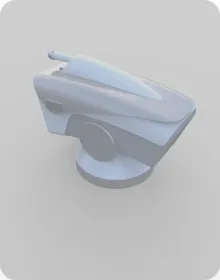
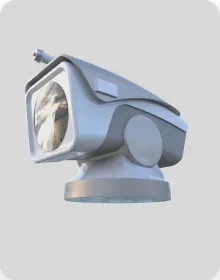
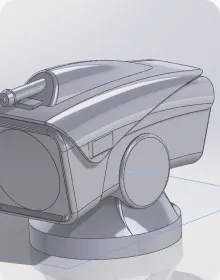
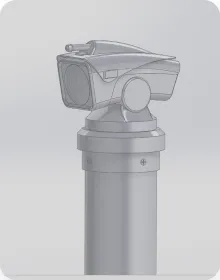
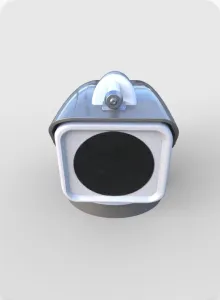
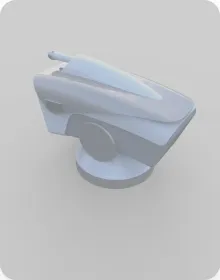
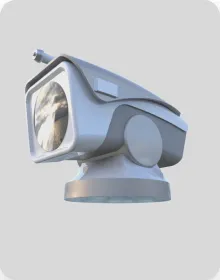
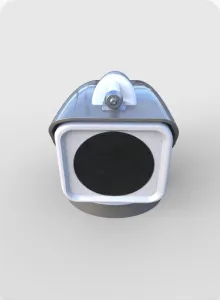
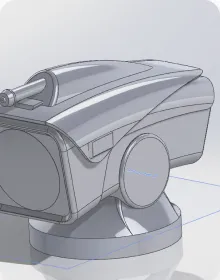
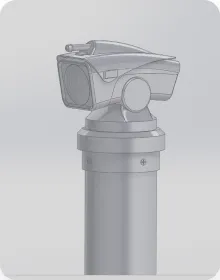
Landi Industries translated conceptual industrial designs into fully parametric SolidWorks PLM models, integrating internal force-absorbing mechanics with a modular, military-inspired payload architecture.
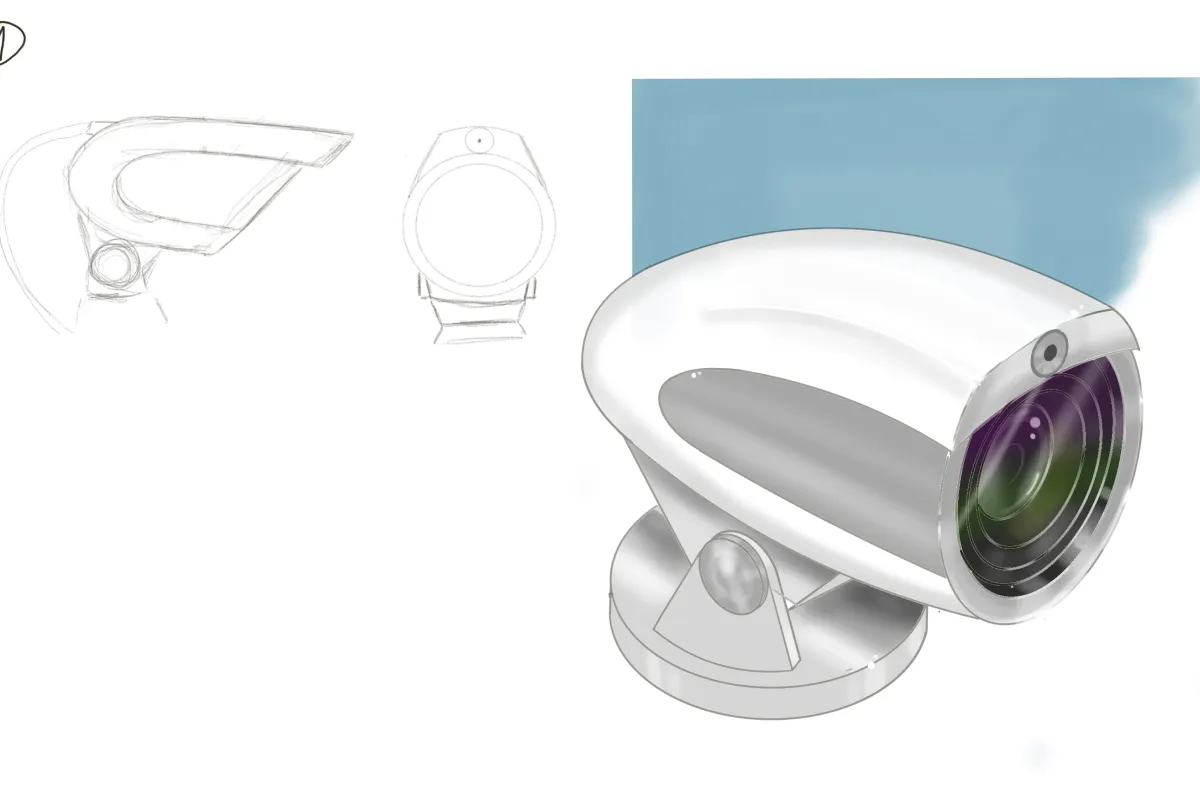
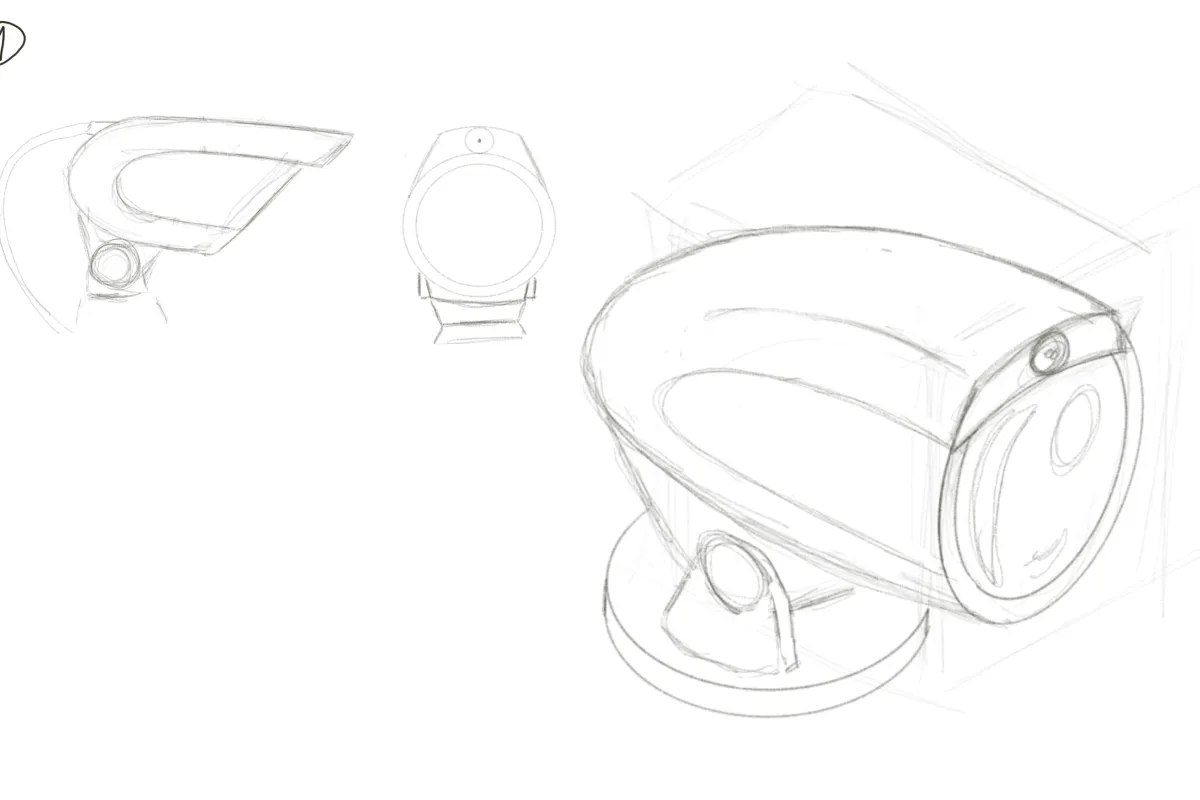
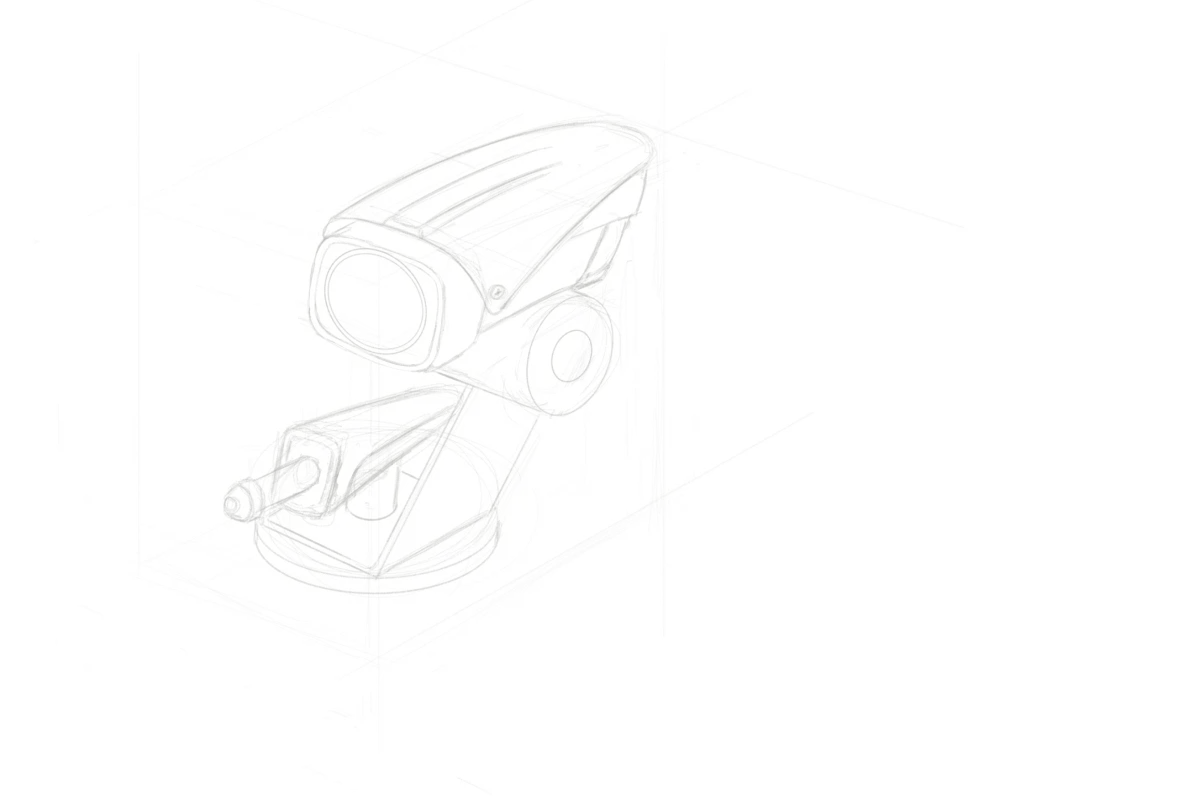
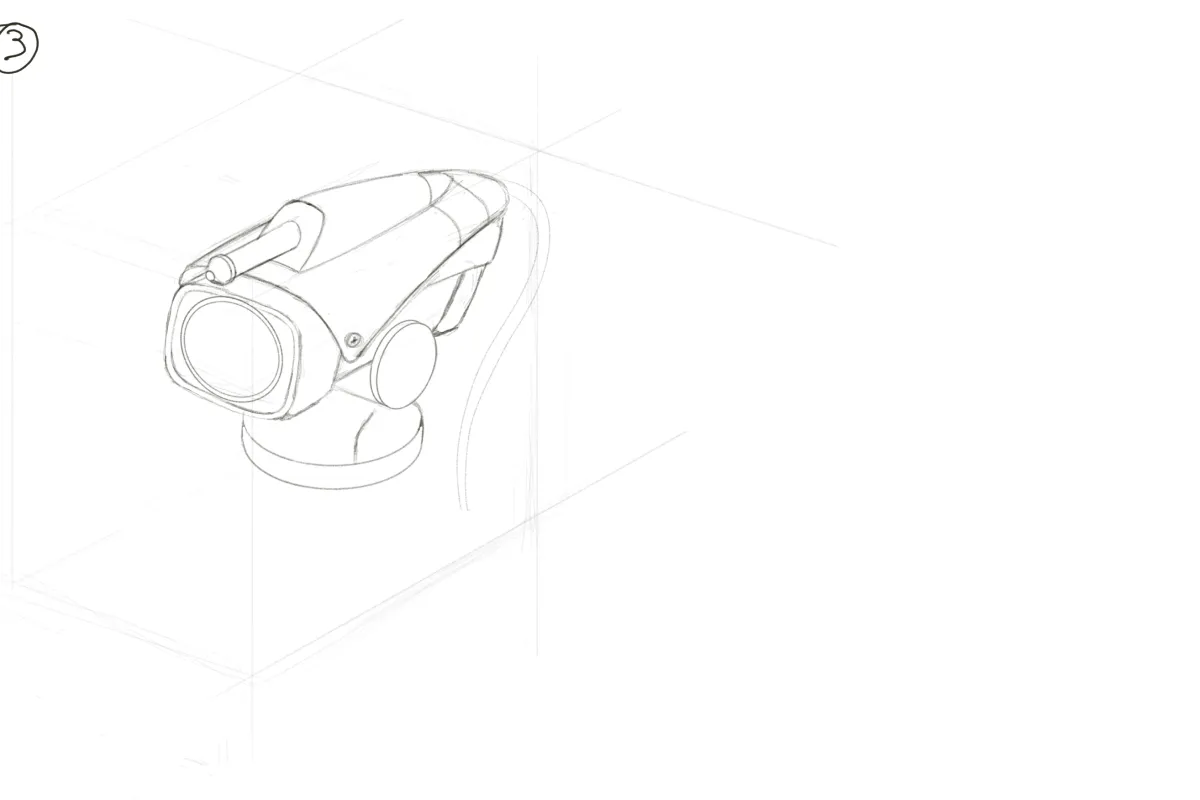
Concept explorations: early hand-drawn ideation and rendered orthographic studies — not production hardware
Internal Structural Force Decoupling & Continuous Panning
Through-Chassis Energy Routing: The water jet was mounted directly on top of the main turret head. By embedding an internal dynamic force absorption core, recoil energy from water bursts is directed downward into the rigidized chassis base, preventing shock wave propagation into the optical plane.
Boundless 360-Degree Rotation: Engineered a central coaxial rotary fluid union paired with a low-noise electrical slip ring. This allowed the turret head to spin continuously 360 degrees without hydraulic pressure loss, line entanglement, or pan-angle blind spots.
Rigidized Turret Base & Reinforced Load-Bearing Platform: The turret base was reinforced to provide a stable foundation for the internal load path.
Tactical Rail System for Multi-Modal Deployment
Taking direct inspiration from modern weapon accessory platforms, Landi Industries integrated a rigid tactical rail interface directly onto the stabilized carriage:
Multi-Modal Deterrence Flexibility: The rail system allows the optical camera to be co-mounted with specialized deterrent modules, including automated high-power green lasers alongside the water nozzle.
Species-Tailored Engagement: When the microcontroller classifies geese, the system triggers the silent, passive laser deterrent to disperse the flock without expending water or energy. When non-responsive species (such as ducks) are identified, the system switches to targeted kinetic water bursts.
Dry-Environment Portability: The rail design enables airports to deploy the unit as a purely optical and laser-based system in hangars or arid airfield perimeters where pressurized water hookups are unavailable.
Manufacturing Blueprinting & Deployment Visualizations
To prepare the client for commercial scaling, Landi Industries generated an extensive Design for Manufacturing and Assembly (DFMA) package:
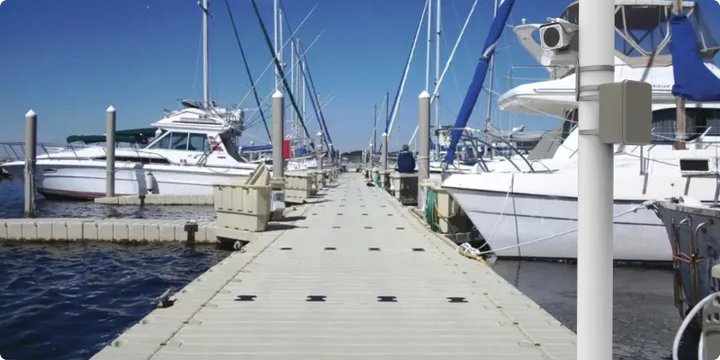
Deployment Visualizations: Created detailed industrial design concept art and technical packaging drawings showing perimeter fence stanchion mounts, temporary mobile trailer setups, and hangar structural truss configurations.
Tiered Manufacturing Plans: Mapped out low-volume CNC and sheet metal fabrication routes versus high-volume cast aluminum and injection-molded composite housings, providing clear BOM cost projections and tooling requirements for commercial production.
The Result
Landi Industries delivered a production-ready, fully validated hardware architecture that transformed an early benchtop prototype into a versatile commercial security asset:
Zero-Jitter Optical Tracking: Internal structural force redirection preserved absolute optical stability during water bursts, maintaining predictive targeting tracks without blinding the camera.
Multi-Modal Active & Passive Deterrence: The tactical rail platform enabled combined laser and water deployment, matching the correct physiological deterrent to specific bird species while permitting waterless deployments.
Energy-Independent Operation: The microcontroller-based edge vision architecture drastically lowered power consumption, enabling sustained, primary battery-powered field operation across unpowered airfield perimeters.
Complete Manufacturing Readiness: Landi Industries provided a comprehensive engineering handoff—including SolidWorks PLM assemblies, full electrical schematics, telemetry specifications, and a tiered manufacturing roadmap ready for contract fabrication.
Services Rendered
Research and Development
- Airfield perimeter operational profiles & environmental deployment analysis
- Cross-industry force mitigation research (marine vehicle turrets & firefighting cannons)
- Low-power microcontroller (MCU) edge vision feasibility & power-budget modeling
- Target audience persona mapping & B2B airport procurement cycle analysis
Design and Creation
- Hand-drawn industrial design concepts & rapid mechanical deployment sketches
- SolidWorks with PLM (complete 3D CAD modeling, chassis rigidization, and mechanism design)
- Decoupled optical frame architecture & marine-style rail recoil isolation system
- Coaxial 360-degree rotational fluid delivery engineering
- Battery-power management & remote telemetry system blueprints
Prototyping & Technical Analysis
- Hydrodynamic recoil impulse modeling & mechanical vibration isolation studies
- Rotational fluid union stress & pressure drop evaluations
- Low-volume CNC vs. high-volume casting manufacturing trade studies
Project Management & Manufacturing Enablement
- Modified Agile Hardware Design (MAHD) milestone delivery
- Complete Design for Manufacturing and Assembly (DFMA) commercial roadmap
- Production-ready technical documentation & investor/customer pitch collateral