
Field Notes from 2035: The Engineering of an Invisible City
I recently spent time at the CES 2026 Food Tech Summit, peering into the 2035 delivery roadmap during a session titled "Food Delivery 2035: Drones, Robots, and Underground Tunnels." If you listen to the marketing, the future is a seamless, autonomous ballet. But if you look at the hardware specs and listen to the women actually building the infrastructure—Heather Rivera (CBO at Wing), Melissa Fahs (CCO at Coco), and Whitney Pegden (SVP/GM at Wonder)—you realize we are currently in an "infrastructure debt" crisis.
For those looking to build or invest in this space, here are my field notes on the hurdles we aren't talking about enough.
The Sky Layer: Engineering the "Invisible Tether"
The primary hurdle for autonomous drones isn't the act of flight; it is persistent airworthiness in high-entropy urban environments. We have moved past the era of "drones as gadgets" and into an era of Aviation-Grade Redundancy that demands we revisit problems many assumed were solved years ago.
Most people entering this space think the finish line is simply securing a landing zone and extending battery life. While those are necessary, they are surface-level concerns. The true engineering friction begins much deeper, where the machine must integrate into the existing urban "nervous system." As we push for deeper integration, the problems shift from basic logistics to complex physics—problems that need fresh eyes because the "high-tech" solutions are proving to be surprisingly fragile.
The Signal Shadow Crisis: In cities like New York or Chicago, skyscrapers act as Faraday cages. GPS—the very heartbeat of autonomous flight—is often "ghosted" or jammed by the surrounding concrete and steel. The technical shift is toward Ground-Based Surveillance Systems (GBSS). These are networks of building-top sensors that "hand off" the drone from one digital tether to the next, ensuring it never relies on a single, fragile satellite connection that could drop in an urban canyon.
The "Lidar Glitch" and the Amazon MK30 Reality Check: A defining "reality check" occurred recently when Amazon briefly grounded its Prime Air MK30 fleet after multiple drones suffered mid-air power losses. The culprit was a software update that made the laser-based Lidar sensors over-sensitive to raindrops. During a light rain, the Lidar mistook falling drops for solid ground. Because the software was programmed to cut the propellers once it "confirmed" a touchdown, the drones essentially committed robot suicide from 200 feet up.
The "Squat Switch" Lesson: This incident revealed a trend where "simplifying" hardware actually removed critical safety layers. In earlier models like the MK27, Amazon used "Squat Switches" (Weight-on-Wheels sensors)—physical metal prongs that depress to confirm touchdown. By removing these in favor of a purely software-and-Lidar approach on the MK30, the system lost its "sanity check." We are now seeing a return to Dissimilar Redundancy, where the flight controller won't cut power unless the high-tech laser and a low-tech physical sensor agree.
The "Invisible Wiring" Problem: While "Sense and Avoid" systems can spot a building, they still struggle with "thin-wire hazards"—utility and internet cables that are nearly invisible to standard sensors during ascent and descent. Just recently, an MK30 in Texas clipped a thin internet cable after completing a delivery. The current fix isn't just better cameras; it's contingent landing logic that allows the craft to detect the physical tension of a snag and self-land instantly before a minor clip becomes a catastrophic crash.
The Thermal Debt: The Real Cost of "Instant"
While we’ve been distracted by the "where" of landing zones and the "how long" of battery life, we’ve largely ignored the physics of the turnaround. Everyone wants their delivery in under ten minutes, but the hardware turnaround is a massive Thermal Management bottleneck that software simply cannot patch.
To make matters worse, we are building this future on a foundation that is already crumbling; much of the U.S. electrical grid—including hubs like San Francisco—dates back to the late 1800s. We are now seeing a massive "Industrial Squeeze" as autonomous fleets compete for power with AI data centers requesting 1,000 megawatts at a time and the relentless growth of EV charging. This places a tremendous burden on existing distribution systems, often forcing residential ratepayers to shoulder the cost of industrial-grade upgrades—a hidden friction that could cost the industry its "social license" to operate.
The Fast-Charging Paradox: To keep an autonomous fleet active, you can’t afford to let a drone sit for an hour to recharge. You need a "gas station" experience. However, rapid-charging a lithium-ion battery for a five-minute turnaround generates intense, localized heat. This doesn't just shorten the battery's lifespan; it creates a safety risk. As current increases, so does the risk of Thermal Runaway, where the battery essentially cooks itself from the inside out.
Active-Cooled Docks: Because of this, the future landing area is evolving from a passive pad into an active heat exchanger. We are seeing a move toward liquid-cooled docking stations. These hubs are designed to create a "thermal handshake" the moment a drone touches down, connecting internal cooling loops to the drone’s battery core. By "pulling" heat out of the cells while "pushing" energy in, these systems allow for high-wattage charging without the risk of combustion.
The Grid Hurdle and Energy Buffers: Most urban wiring isn't designed for a 100-drone "instant-charge" surge. If ten drones land at once, the instantaneous peak load can be enough to trip a city block's breakers. The unglamorous solution we are seeing is Energy Buffers—massive on-site battery banks (essentially industrial-scale Powerwalls) that slowly "sip" power from the aging city grid all day just to "dump" that power into the drones in high-speed, high-heat bursts.
The "Boring" Hardware Reality: This is where the industry needs a fresh look. We need more than just "better batteries"; we need better Materials Science in our landing pads and smarter Grid-Edge Infrastructure. The success of 2035 depends on how we manage the "thermal debt" generated by our need for speed.
The Sub-Surface Logic: Reclaiming the Streets
Perhaps the most radical "field note" from the 2035 roadmap is that the future of delivery is actually moving underground. We’ve spent decades trying to optimize the surface, but sidewalks and streets are "high-entropy" environments. A toddler, a stray dog, or an erratic driver is a technical anomaly that even the most advanced AI struggles to predict with 100% certainty. The solution being pioneered by companies like Pipedream Labs is to move the bulk of our logistics into dedicated 12-inch "logic pipes" buried just beneath the surface.
This is where the "unglamorous" work of the next decade lives. It isn't about sci-fi teleportation; it’s about the blue-collar engineering of city-wide retrofitting.
The Interoperability Crisis: Currently, the industry is a collection of "walled gardens." A drone from Company A cannot drop a package into an underground rover from Company B, which in turn can't interface with a smart locker from Company C. For the "Logic Pipe" to work, we need a "USB for Buildings"—standardized hardware apertures and Interoperability Standards that allow different robotic systems to "handshake" without human intervention.
The "Last 50 Feet" Challenge: The hardest part of the journey isn't the mile-long tunnel; it’s the vertical lift into a home or office. Integrating autonomous "portals" into the foundations of existing 100-year-old buildings is an engineering nightmare of seismic bracing and utility rerouting. As the World Economic Forum has noted, technology isn't the biggest obstacle to this vision; it’s the complex web of regulation, building codes, and urban policy. We need a fresh look at Building Code Modernization that treats a delivery hatch with the same structural importance as a water main or an electrical panel.
Navigating the Urban Maze: Boring 12-inch tunnels under a modern city is a game of "Geological Tetris." Our maps of what lies beneath our streets are often decades out of date. The hurdle here is Subsurface Uncertainty—navigating around existing fiber optics, gas lines, and crumbling Victorian-era brick sewers. The success of this layer depends on advanced trenchless boring technology that can "see" obstacles before the drill bit hits them.
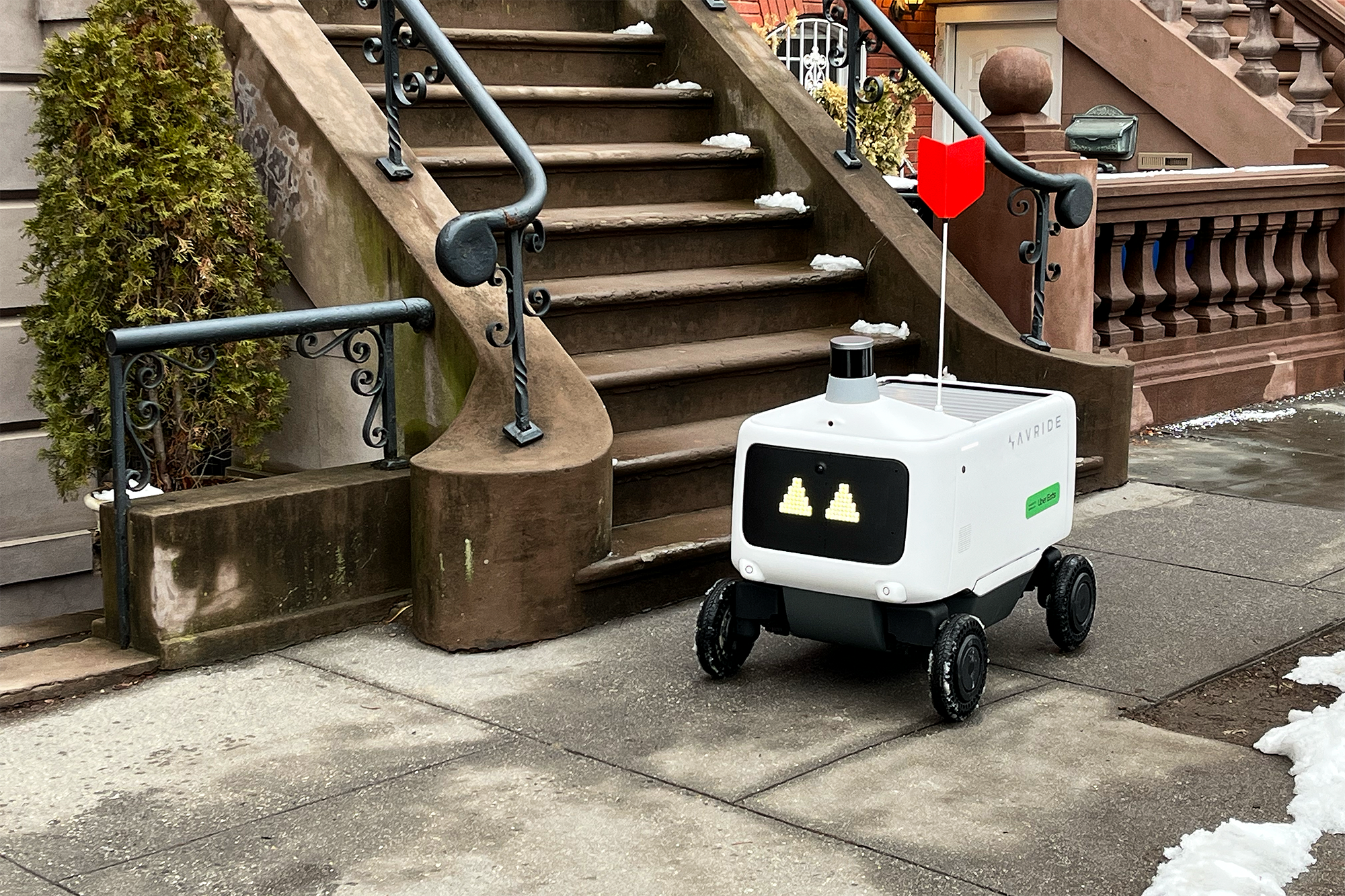
The "Polite" Robot: When these underground rovers finally surface to complete a delivery, they face a social hurdle. We are seeing the rise of Behavioral Hardware—robots with external lighting and "expressive" movements that signal their intent to pedestrians. It turns out that making a robot "safe" is only half the battle; you also have to make it "polite" enough that people don't view it as an invasive nuisance.
The Conclusion: Building the Ground Truth
I was thankful for The Spoon to host such an event because it showed the future of food isn't just about better recipes; it’s about better infrastructure. After peering into the 2035 roadmap, my takeaway is clear: we have reached the end of the "gadget" phase of autonomy. The software is ready, but the physical world is lagging behind. To bridge this gap, we have to stop looking for the next flashy drone and start looking at the "boring" hardware—the redundant sensors, the liquid-cooled charging hubs, and the standardized subsurface pipes—that will form the physical skeleton of our cities.
The transition to 2035 will be won by those who solve the unglamorous problems of physics, thermal debt, and mechanical sanity-checks. We are no longer just delivering packages; we are re-engineering the way a city breathes.
As we move forward, the question for every developer, city planner, and resident isn't about the tech itself, but the trade-offs we are willing to make for a more efficient world.